Unit 5Human physiology
Breathing and gas exchange
Follow air into an alveolus, then follow gases between lungs and tissues.
Lesson animations
All animationsFour oxygen-binding sites
Each haem group of haemoglobin can bind one oxygen molecule. Follow four molecules as they load at high oxygen pressure and are released where the pressure is lower.
Detailed lesson
From inhaled air to the exchange surface
The conducting airways carry, warm and moisten air, but most gas exchange takes place across alveolar walls. The alveoli have a large area and thin walls next to capillaries. Oxygen diffuses from higher to lower partial pressure across this barrier, and carbon dioxide generally diffuses in the opposite direction. Moving air and blood help maintain these gradients.
What changes when an active tissue needs oxygen?
Oxygen is mainly carried on haemoglobin. A tissue with higher carbon dioxide and lower pH encourages haemoglobin to release more oxygen at a given partial pressure, a relationship called the Bohr effect. Much of the carbon dioxide carried back to the lungs travels as bicarbonate. These transport forms help both gases move between tissue and lung.
Worked example
Calculate how much fresh air reaches the alveoli
In a simple example, each breath takes in 500 mL and 150 mL remains in the conducting airways. At 12 breaths per minute, the total ventilation is 500 × 12 = 6,000 mL/min. Fresh air reaching the exchange region is (500 − 150) × 12 = 4,200 mL/min. The conducting airway volume explains the difference.
Quick revision
- A larger partial-pressure difference promotes faster diffusion across the same barrier.
- Some inhaled air remains in the conducting airways at the end of a breath.
Step-by-step guide
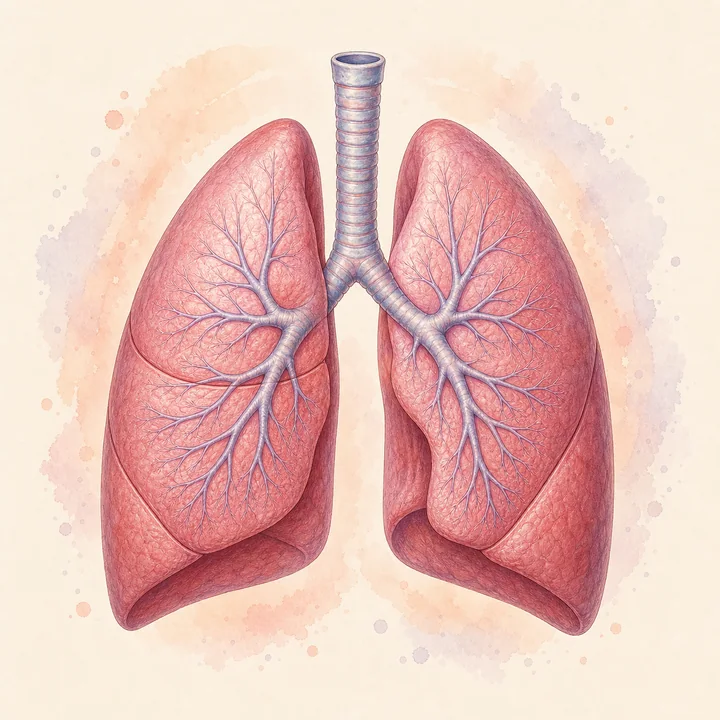
Ventilation
Animals exchange gases across surfaces such as moist skin, gills, tracheae or lungs. In humans air moves from the nose through the pharynx, larynx, trachea, bronchi and bronchioles to alveoli. When the diaphragm and external intercostal muscles contract during quiet inspiration, thoracic volume rises and pressure falls below atmospheric pressure.
Read all steps
- Ventilation
Animals exchange gases across surfaces such as moist skin, gills, tracheae or lungs. In humans air moves from the nose through the pharynx, larynx, trachea, bronchi and bronchioles to alveoli. When the diaphragm and external intercostal muscles contract during quiet inspiration, thoracic volume rises and pressure falls below atmospheric pressure.
- Exchange in lungs and tissues
Partial-pressure gradients drive O₂ from alveoli to blood and CO₂ in the opposite direction. At tissues, O₂ leaves blood and CO₂ enters it. Haemoglobin carries most oxygen, while most carbon dioxide travels as bicarbonate. High CO₂ and low pH generally favour oxygen unloading in active tissues.
- Volumes and regulation
Tidal volume is the air moved in one quiet breath. Inspiratory and expiratory reserve volumes are the extra amounts moved by effort. Residual volume remains after maximum exhalation. Brainstem centres coordinate breathing and respond strongly to CO₂-related changes in pH.
- Respiratory disorders
Asthma can narrow airways. Emphysema damages alveolar walls, reducing the exchange surface and elastic recoil. Long exposure to some occupational dusts can scar lung tissue and make gas exchange harder.
NEET practice question
+4 correct · −1 incorrect · 0 skipped