Unit 5Human physiology
Blood and double circulation
Trace a blood cell around the two circuits and see how heart activity keeps blood moving.
Lesson animations
All animationsThe heart's electrical pathway
The impulse starts in the sinoatrial node, reaches the atrioventricular node, then travels through the conducting bundle toward the apex and up the ventricular walls.
Detailed lesson
Valves open and shut with pressure
During ventricular filling, pressure on the atrial side opens the atrioventricular valves. When the ventricles contract, their increasing pressure closes those valves. The outflow valves only open once ventricular pressure exceeds pressure in the aorta or pulmonary artery. Heart sounds mainly accompany valve closure and the resulting vibrations.
Separate blood type from clot formation
ABO groups depend on A and B antigens on red blood cells. Antibodies in plasma can bind the corresponding unfamiliar antigens and cause cells to agglutinate. Clotting at vessel injury is a different process involving platelets and a fibrin network. Both can make a sample look clumped, but the underlying mechanisms differ.
Worked example
Calculate cardiac output
If a ventricle ejects 70 mL per beat and the heart rate is 72 beats per minute, the cardiac output is 70 × 72 = 5,040 mL/min, about 5 L/min. This is the output of one ventricle. Adding the two ventricles together would count blood passing through the pulmonary and systemic loops twice.
Quick revision
- Pressure differences drive passive valve opening and closure.
- Cardiac output equals heart rate multiplied by stroke volume.
Step-by-step guide
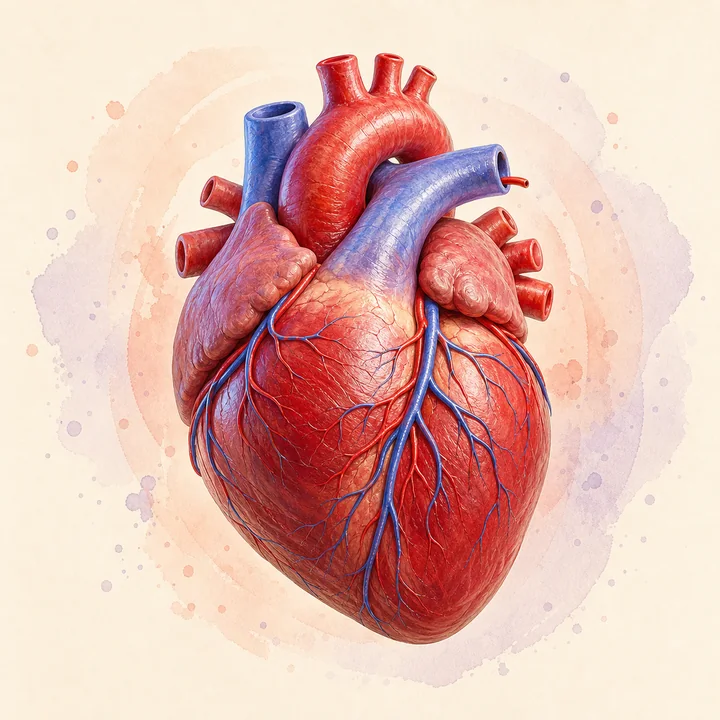
Blood and lymph
Plasma carries dissolved substances. Red cells carry gases, white cells defend, and platelets aid clotting; fibrin forms a clot mesh. ABO groups reflect A and B antigens, with corresponding antibodies against the ABO antigens a person lacks. Rh status depends on the D antigen. Lymph contains lymphocytes, returns excess tissue fluid and transports absorbed fats from the intestine.
Read all steps
- Blood and lymph
Plasma carries dissolved substances. Red cells carry gases, white cells defend, and platelets aid clotting; fibrin forms a clot mesh. ABO groups reflect A and B antigens, with corresponding antibodies against the ABO antigens a person lacks. Rh status depends on the D antigen. Lymph contains lymphocytes, returns excess tissue fluid and transports absorbed fats from the intestine.
- Lung circuit
Systemic venous blood reaches the right atrium, then the right ventricle through the tricuspid valve. Pulmonary arteries carry it to lung capillaries. Pulmonary veins return oxygenated blood to the left atrium. Arteries carry blood away from the heart and veins carry it toward the heart.
- Body circuit and heartbeat
Blood goes through the mitral valve to the left ventricle and through the aortic valve to systemic arteries. Valves respond to pressure differences and prevent backflow. Pacemaker activity starts at the sinoatrial node, then travels via the AV node and conduction fibres. Diastole fills chambers and systole ejects blood. Cardiac output equals heart rate multiplied by stroke volume.
- ECG and regulation
On an ECG, P reflects atrial depolarisation, QRS reflects ventricular depolarisation and T reflects ventricular repolarisation. Autonomic nerves and hormones change rate or force. Hypertension is persistently high arterial pressure. Coronary disease can reduce blood supply to the heart, causing angina. In heart failure, cardiac pumping or filling cannot adequately meet the body’s needs.
NEET practice question
+4 correct · −1 incorrect · 0 skipped