Unit 5Human physiology
Excretion and urine formation
Follow filtrate through a nephron and see how the kidneys adjust water and salt balance.
Lesson animations
All animationsThe tubule recovers glucose
Filtered glucose moves from the proximal tubule across its epithelium and returns to nearby blood.
Detailed lesson
Follow a substance through a nephron
Filtration moves water and many small molecules out of glomerular capillaries into the nephron. Reabsorption then retrieves useful water and solutes from the tubule into the blood. Secretion moves some additional substances from blood into the tubule. For a tracked substance, the amount excreted equals the amount filtered minus reabsorbed plus secreted.
Two roles in concentrating urine
The descending limb of the loop of Henle is relatively permeable to water. The ascending limb helps move salts into the surrounding tissue while allowing little water to follow. These differences help establish the medullary concentration gradient. ADH can then make the collecting duct more permeable to water, allowing it to use that existing gradient.
Worked example
Why filtrate volume is much larger than urine volume
A textbook filtration rate of 125 mL/min gives 125 × 1,440 = 180,000 mL, or 180 L, of fluid filtered over 24 hours. If only 1.5 L becomes urine in the same example, most of the original filtered water has returned to the body. Filtration rate and urine flow rate therefore measure very different things.
Quick revision
- Tubular reabsorption sends materials from the filtrate back to the blood.
- A medullary gradient and water permeability together support urine concentration.
Step-by-step guide
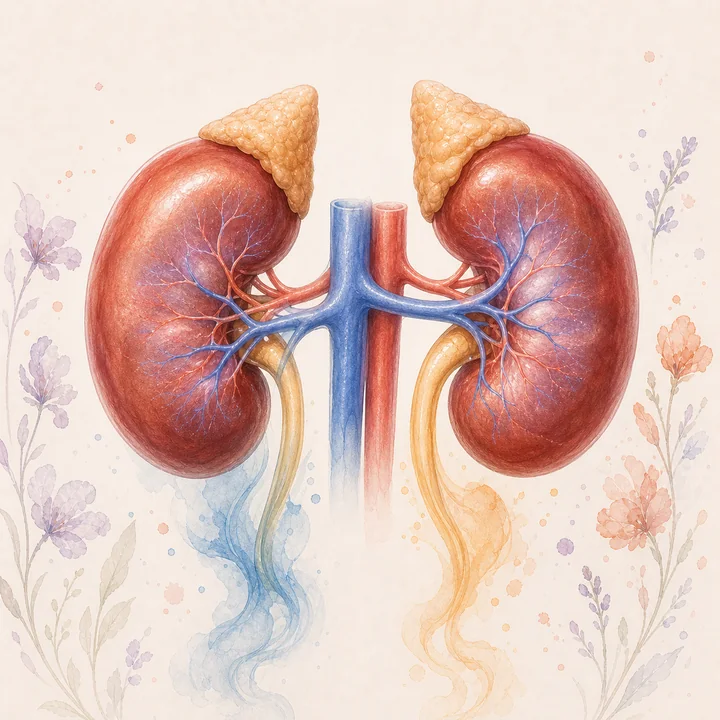
Wastes and the urinary system
Many aquatic animals release ammonia. Mammals convert much of their nitrogen waste to urea. Birds and many reptiles excrete uric acid with little water. Human urine flows from kidneys through ureters to the bladder and out via the urethra. The lungs also remove CO₂, and sweat releases small amounts of salts and urea.
Read all steps
- Wastes and the urinary system
Many aquatic animals release ammonia. Mammals convert much of their nitrogen waste to urea. Birds and many reptiles excrete uric acid with little water. Human urine flows from kidneys through ureters to the bladder and out via the urethra. The lungs also remove CO₂, and sweat releases small amounts of salts and urea.
- Filtration, reabsorption and secretion
Glomerular pressure filters water and small solutes into Bowman’s capsule, while cells and most proteins stay in blood. Tubules reabsorb useful water and solutes and secrete selected ions and wastes into the filtrate. Opposite flows in the loop of Henle and nearby vasa recta help establish and maintain the medullary concentration gradient.
- Water and salt regulation
ADH increases collecting-duct water permeability. Low renal perfusion can activate renin, leading to angiotensin II and aldosterone and favouring salt retention. Atrial natriuretic factor promotes sodium loss and counteracts pressure-raising responses. Too little ADH action can cause diabetes insipidus and large volumes of dilute urine.
- Excretory disorders
Kidney stones are crystallised deposits, nephritis is kidney inflammation, and renal failure can allow urea and other wastes to accumulate. Dialysis uses a semipermeable barrier to remove selected wastes and excess water when natural filtration is inadequate.
NEET practice question
+4 correct · −1 incorrect · 0 skipped