Unit 5Human physiology
Neural control and impulses
Track a signal from a neuron’s membrane to its next target and locate it in the nervous system.
Lesson animations
All animationsImpulse jumps between nodes
In a myelinated axon, local currents carry excitation under each sheath. The action potential is regenerated at successive exposed nodes.
Detailed lesson
Distinguish signal size from signal frequency
A weak stimulus can produce a small local voltage change without triggering an action potential. Once the trigger region reaches threshold, the axon's action potential follows a characteristic size and time course. A stronger sustained stimulus can produce more frequent impulses rather than much larger individual impulses. This is one way neurons represent stimulus strength.
What makes an input excitatory or inhibitory?
A neurotransmitter acts through its receptor on the receiving cell. Some receptor effects bring the membrane voltage closer to threshold; others make an impulse less likely. One neuron may receive many of both kinds of input. The combined effect at the trigger region helps determine whether an action potential starts.
Worked example
Trace a withdrawal reflex
When a hand contacts a hot surface, a sensory neuron carries a signal toward the spinal cord. Interneurons help pass signals to motor neurons that activate muscles which withdraw the hand. The spinal circuitry can organise the movement quickly, while other pathways carry information toward the brain for awareness of the stimulus.
Quick revision
- Action potential frequency can change even if each impulse is similar in size.
- The receiving cell combines excitatory and inhibitory signals.
Step-by-step guide
Organisation
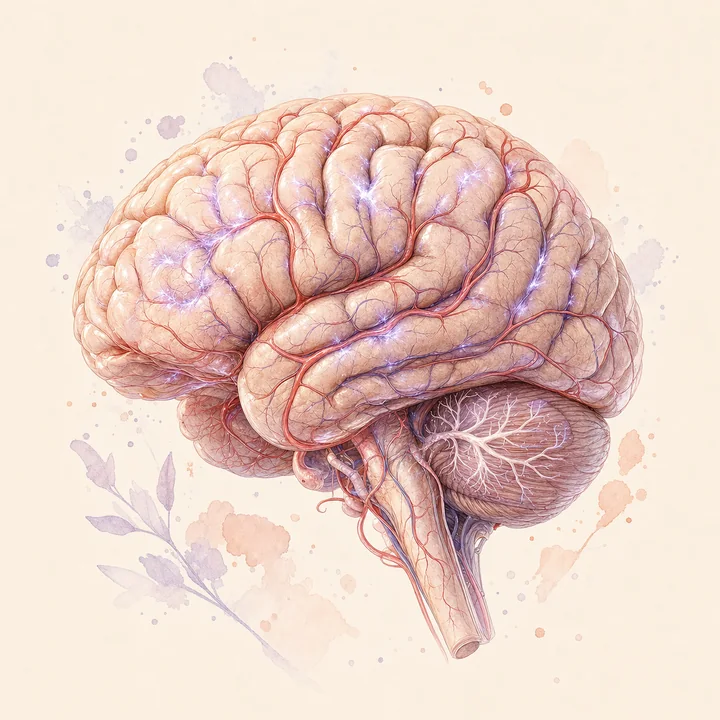
Dendrites receive input, a cell body integrates it and the axon sends signals toward a target. The central nervous system comprises brain and spinal cord. Peripheral nerves carry sensory and motor signals. The autonomic or visceral system regulates internal organs through branches including sympathetic and parasympathetic pathways.
Read all steps
- Organisation
Dendrites receive input, a cell body integrates it and the axon sends signals toward a target. The central nervous system comprises brain and spinal cord. Peripheral nerves carry sensory and motor signals. The autonomic or visceral system regulates internal organs through branches including sympathetic and parasympathetic pathways.
- Generating an impulse
Ion gradients and membrane permeability keep the resting interior negative. At threshold, voltage-gated sodium channels open and inward sodium depolarises the membrane. Potassium movement out then helps repolarise it. The short refractory period limits immediate refiring.
- Propagation and synapse
The depolarised region triggers the next region. In a myelinated axon, impulses are regenerated at nodes of Ranvier, speeding conduction. At a chemical synapse, terminal calcium entry causes neurotransmitter release. The transmitter binds receptors on the next cell.
NEET practice question
+4 correct · −1 incorrect · 0 skipped